
Desperate Response For the Losing Transition - Part 2
Claim 2: 96 percent of new electricity generation globally came from sun and wind technologies and batteries

Environmentalist Bill McKibben, in articles published in The New Yorker (July 9, 2025, “4.6 Billion Years On, the Sun Is Having a Moment”) and The New York Times (July 18, 2025, “Why Trump’s War on Solar Power Will Fail”), claims that 96% of new global electricity generation in 2024 came from solar, wind, and battery storage or renewables. He frames renewables as poised to dominate, even as Inflation Reduction Act (IRA) subsidies expire on December 31, 2025, potentially raising clean energy costs by 30%. This blog, the second in a series, critically examines McKibben’s claim using 2024 energy data, addressing inconsistencies in terminology, the distinction between capacity and generation, and the broader context of energy emissions.
Claim #2 96% of new electricity generation globally came from sun and wind [or renewables] technologies and batteries
1. Electricity vs. Total Energy
McKibben’s focus on electricity generation overlooks the broader energy landscape. Electricity and heat account for 29.7% of global greenhouse gas (GHG) emissions, with transport, industry, and agriculture contributing the remaining 70% (see Figure 1, showing GHG emissions by sector). This distinction is critical because advocates for net-zero emissions often push electrification—electric vehicles, heat pumps—to reduce reliance on fossil fuels. However, by emphasizing electricity, McKibben sidesteps the 70% of emissions from non-electric sources, limiting the scope of his claims about renewable energy’s impact.
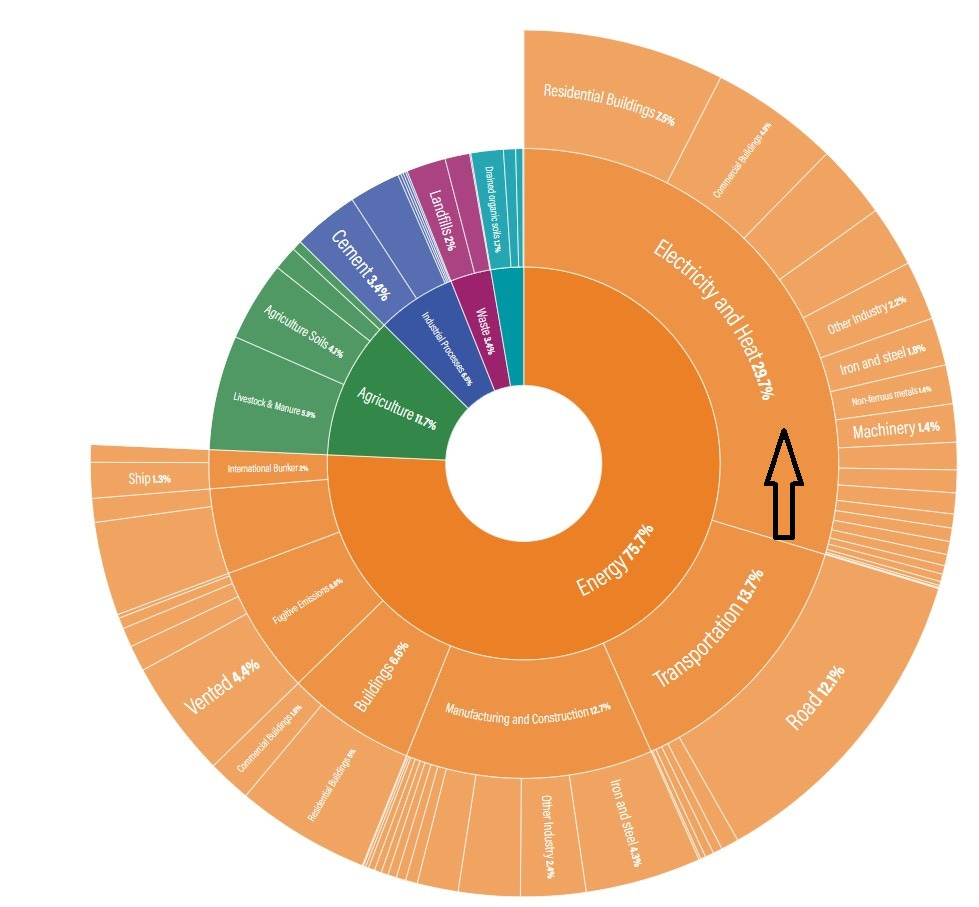
Figure 1 - World Greenhouse Gas Emissions by sector. Electricity and heat contribute 29.7%, while transport (15%), industry (30%), and agriculture (15%) dominate the rest
2. Inconsistent Terminology
McKibben’s claims shift between terms, creating confusion. On July 9, he stated, “Ninety-six per cent of the global demand for new electricity was met by renewables,” but on July 18, he said, “Almost 96 percent of new electricity generation globally came from sun and wind technologies and batteries.” The International Energy Agency (IEA) defines renewables as energy from solar, wind, hydropower, biomass, geothermal, and biofuels, all replenished faster than consumed. By switching from “renewables” to “sun and wind,” McKibben excludes significant contributors like hydropower (15% of global renewable electricity in 2024) and biomass (2-3%). This inconsistency overstates solar and wind’s role.
3. Capacity Versus Generation (Output)
A key issue in McKibben’s claims is the conflation of installed capacity (maximum potential output) with actual generation (energy produced). Solar and wind are intermittent, producing less than their rated capacity due to weather and time constraints. For example, a 100 kW solar array with a 12.9% capacity factor—reflecting 2024’s global average (Statistical Review of World Energy, 2025)—generates an average of 12.9 kW. Wind’s global capacity factor is higher at 25.3%, but still far below fossil fuel plants (e.g., coal at 80%). Advocates often cite capacity because it yields larger numbers, but generation reflects real-world output. Without clarity on this distinction, claims like McKibben’s can mislead readers about renewables’ actual contribution.
4. Evaluating the 96% Claim
McKibben’s claim that 96% of new electricity generation globally in 2024 came from solar, wind, and batteries lacks references and is factually inaccurate. Table 1 shows global electricity generation by fuel type for 2023 and 2024, revealing that renewables accounted for 51.8% of new generation, with solar and wind contributing 50.2%. For capacity, the International Renewable Energy Agency (IRENA) reports that 92.5% of new electricity generation capacity added globally in 2024 was renewable. This figure, close to McKibben’s 96%, suggests he likely meant capacity, not generation.

Table 1 - 2024 World Energy Consumption by Fuel Type
Renewables grew by 51.8%, solar and wind by 50.2%, but fossil fuels still dominated total generation. In the U.S., McKibben’s claim is more accurate: 93% of new generating capacity in 2024 came from solar (61%), wind (10%), and battery storage (21%). To align with data, McKibben’s statements should be reworded:
In 2024, 51.8% of new global electricity generation was from renewables.
In 2024, 92.5% of new global electricity capacity was from renewables.
In 2024, 50.2% of new global electricity generation came from solar and wind.
The second half of the sentence was correct:
In the U.S., 93% of new capacity came from solar, wind, and battery storage.
Conclusions
McKibben’s 96% claim overstates renewable generation but aligns closely with global capacity additions (92.5%). His inconsistent use of “renewables” vs. “solar and wind” and lack of references obscure the true progress of wind and solar, which, while significant, accounted for 14.8% of global electricity in 2024. The focus on electricity, representing 29.7% of GHG emissions, also sidelines the challenge of decarbonizing transport, industry, and agriculture. The EIA’s assumption that stakeholders understand capacity vs. generation differences is optimistic, as McKibben’s errors demonstrate. For example, when EIA announces a renewable project “powering one million homes,” it reflects peak capacity, not average output, which may be 25-35% of that total. Renewables are advancing, but their intermittent nature and the electricity sector’s limited share of emissions mean fossil fuels will persist without broader electrification and clear policy. Policymakers and advocates must use accurate data to ensure realistic discussions about the energy transition, avoiding exaggerated claims that undermine credibility.